Tanjore Painting Colours and Brushes: What We Use and Why
Written by
Vibha Raj
The poster paints we teach with, the lesson-by-lesson order a Tanjore deity is coloured in, and the fine brushes that make the face and outlines possible.
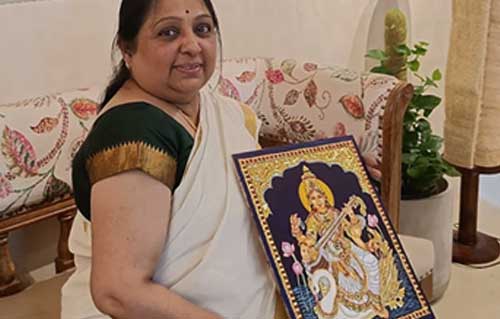
By Vibha Raj, Founder and Tanjore Artist at Tanjore Collective. Vibha learned the art from her mother, master artist Vani Bhaskar, and teaches the faces and finest detailing in our courses herself.
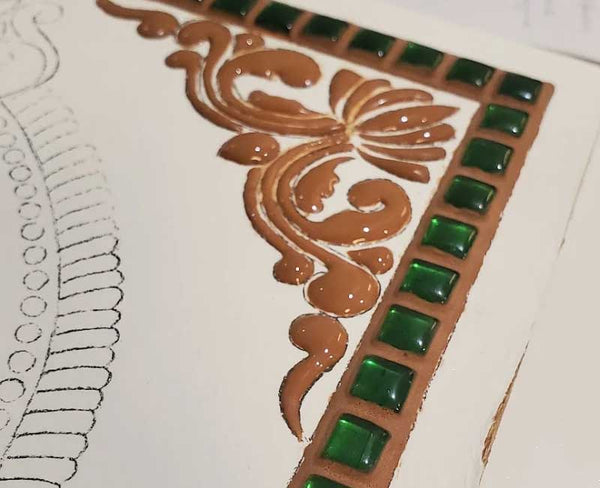
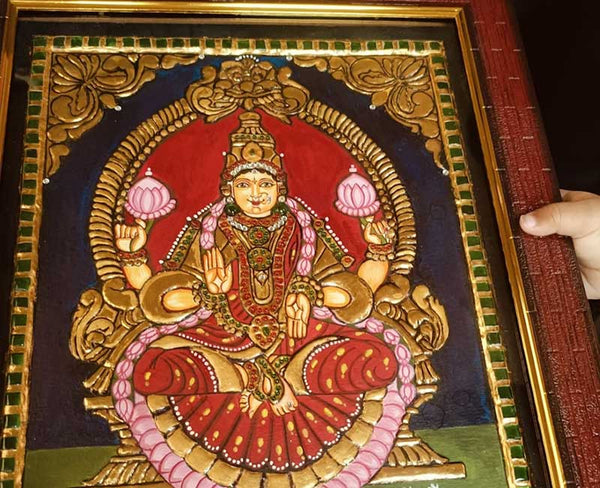
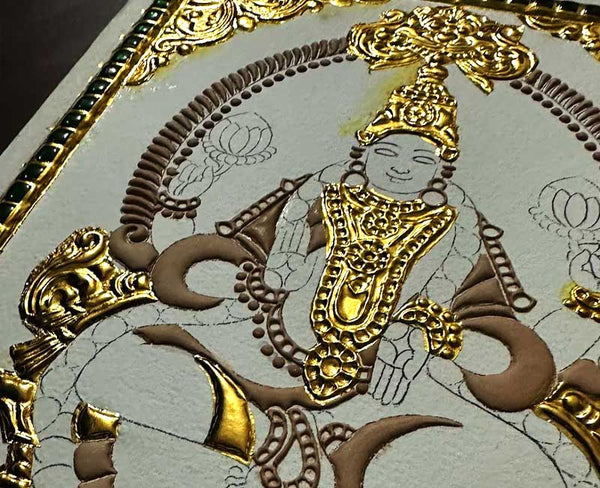
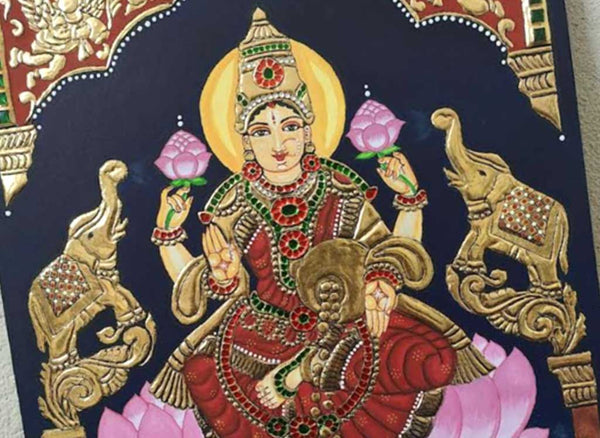
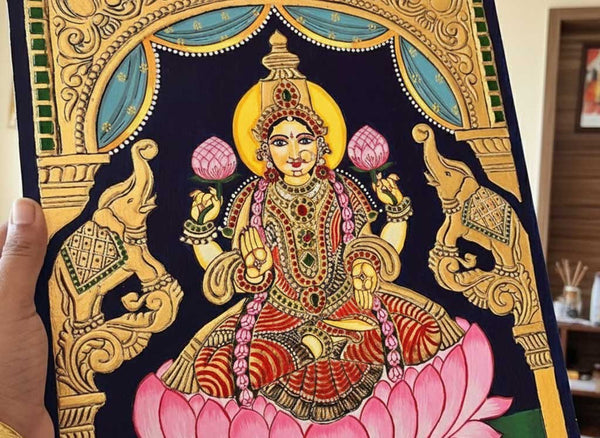
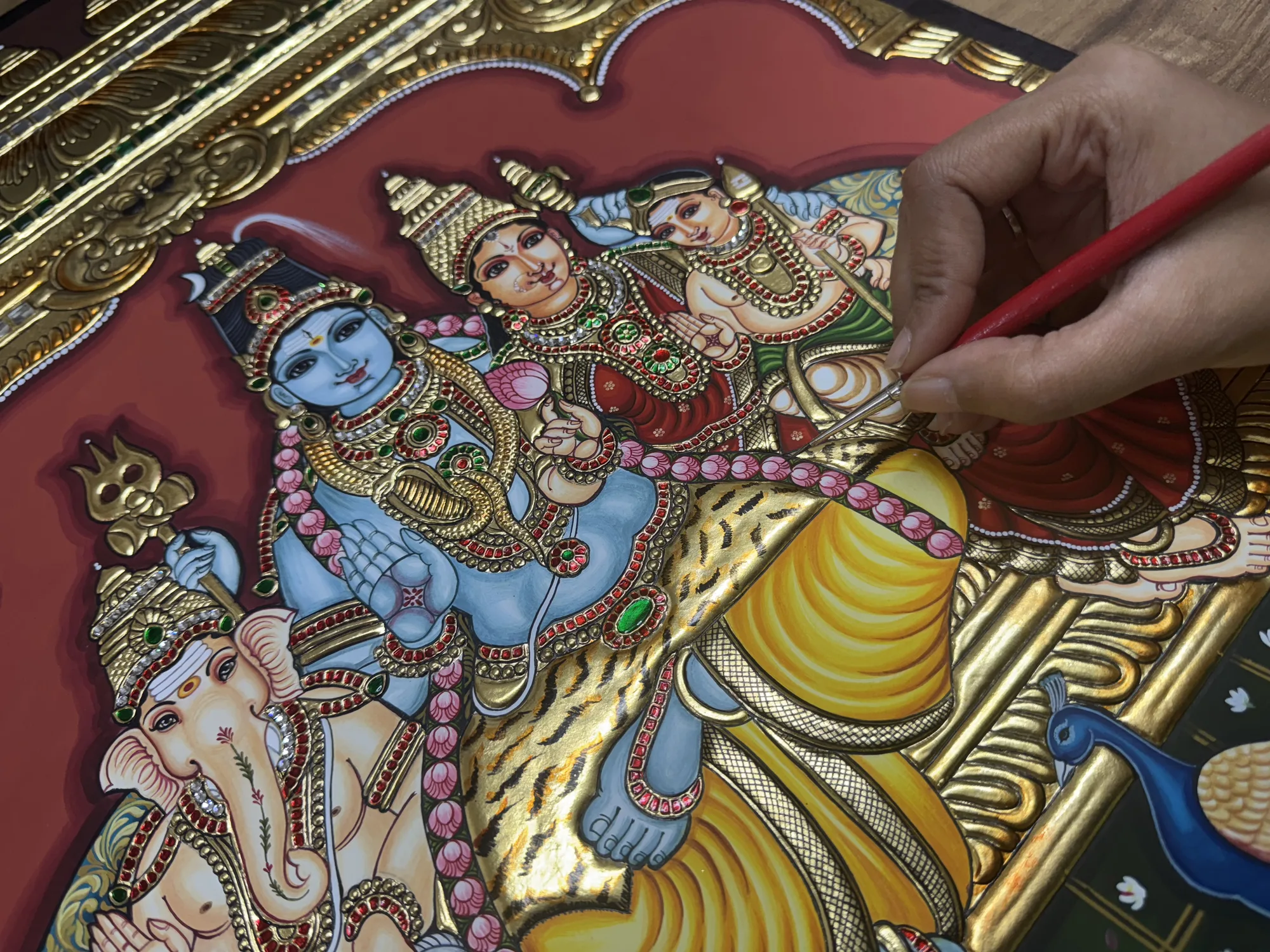
In our studio, Tanjore paintings are coloured with poster paints, applied with fine, professional-grade brushes once the gesso relief, kundan stones and 24 karat gold are already in place. The colour goes on in a set order: the aura and lotus first, then the garments, the body, the face, the background, and finally the fine black outlines. Done this way, the colours stay clean around the gold, and the most delicate work comes when your hand is ready for it.
If you're about to pick up a brush for the first time, it's normal to feel a little nervous here. The gold is laid, the relief looks beautiful, and now you have to add paint. Don't worry. Colour in a Tanjore painting is calm, patient work, done one area at a time. This guide walks you through the paints we teach with, the exact order we paint in, and the brushes that make the fine detail possible. For the full picture of everything that goes into a painting, see our guide to Tanjore painting materials.
At a glance
- Paints: we teach with poster paints.
- When: after the board, gesso relief, kundan stones and 24 karat gold are done.
- Order: aura and lotus, garments, body, face, background, outlines, then crystals.
- Brushes: our Essentials Material Kit includes four premium, professional-grade brushes.
Which paints are used in Tanjore painting?
We teach Tanjore painting with poster paints. Every one of our DIY video courses has a lesson devoted to them (it's called "Introduction to poster paints" or "Working with poster paints") just before the painting begins.
The tradition favours rich, saturated colour: deep reds and greens, warm skin tones, and a deep background colour that lets the gold shine. Part of learning the craft is learning to mix those colours and apply them evenly, building depth in layers rather than in one heavy coat. The colour sits around and between the gold, so it has to be laid neatly, right up to the edges of the relief.
Where colour sits in the whole process
Paint comes surprisingly late. Here's the order we teach, so you can see where it fits:
| Stage | Materials |
|---|---|
| 1. Preparing the canvas and transferring the sketch | Plywood board, chalk powder, Arabic gum (our kits come pre-sketched) |
| 2. Embossing (gesso relief) | Chalk powder and Arabic gum paste |
| 3. Setting stones | Kundan stones |
| 4. Gold | 24 karat gold sheets |
| 5. Painting | Poster paints and fine brushes |
| 6. Finishing | Swarovski crystals |
If you'd like to understand the stages before the paint, read about preparing the board and kundan stones and crystals.
In what order is a Tanjore painting coloured?
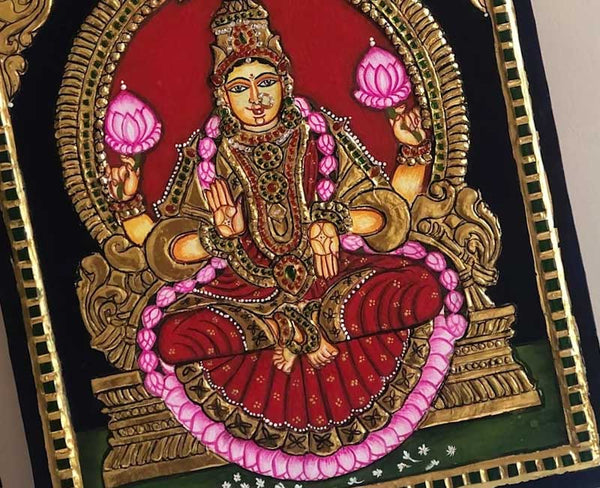
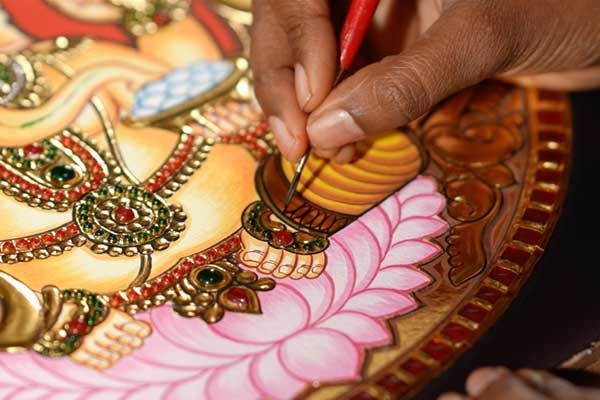
A Tanjore painting is coloured from the surroundings inward and from broad areas to fine ones, with the face near the end and the outlines last. The exact steps change a little with each deity, but the rhythm is the same. Here's the order from our Goddess Lalitha Devi DIY course, lesson by lesson:
- Painting the aura and the lotus
- Painting the sugarcane (the Devi's bow)
- Painting the cushion
- Painting the saree and blouse
- Painting the inner background
- Painting the carpet
- Painting the body
- Painting the face
- Adding black outlines
- Painting the background
- Painting the braid and saree border
- Painting the flowers and dots
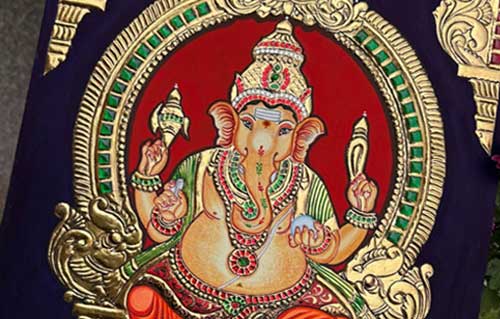
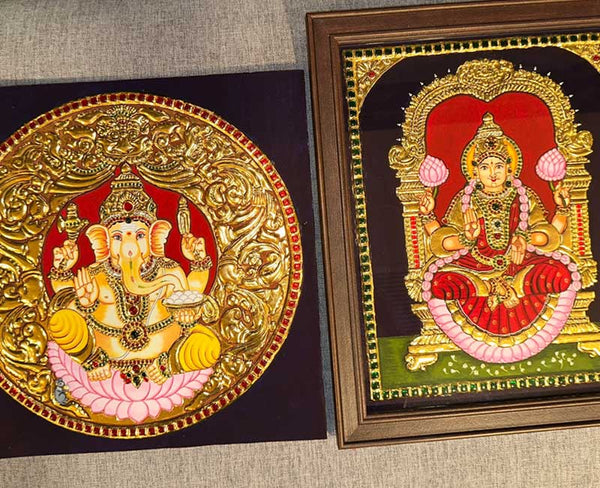
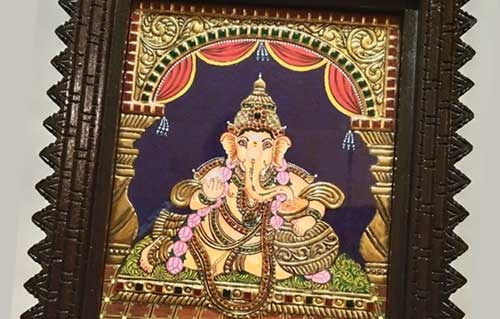
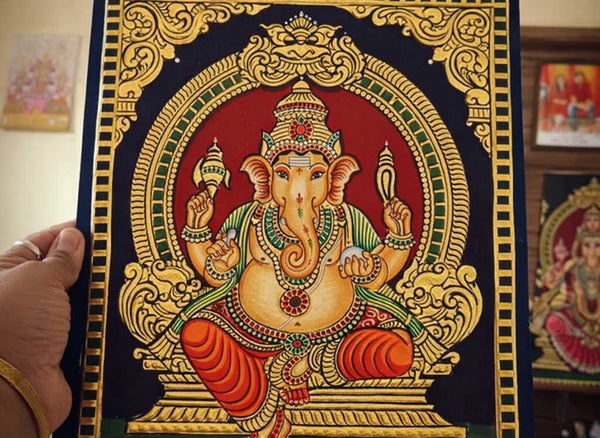
Other deities follow the same pattern with their own details. In our Lakshmi and Saraswati courses, you paint the lotus, then the saree, then paint and shade the body, then the face, before applying flat colours to the background, painting the carpet and adding outlines. In our Ganesha course, you add outlines to the gold emboss first, then paint his dhoti, the lotus, the body and the face, then his mouse and ladoos, the background and the black outlines.
Why this order works
Starting with broad areas like the lotus and garments lets you get comfortable with the paint before you reach anything delicate. By the time you paint the body, and especially the face, your hand already knows how the paint flows and how much to load on the brush. Shading the body gently, as we teach in our Lakshmi and Saraswati courses, is what makes the deity feel rounded and alive rather than flat.
The face: the most delicate stage
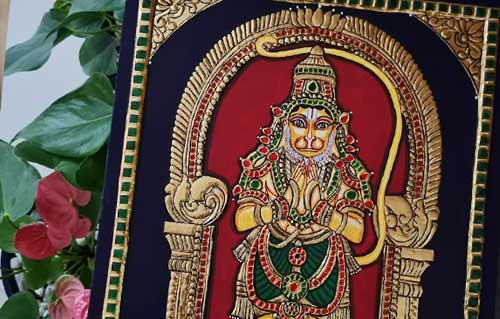
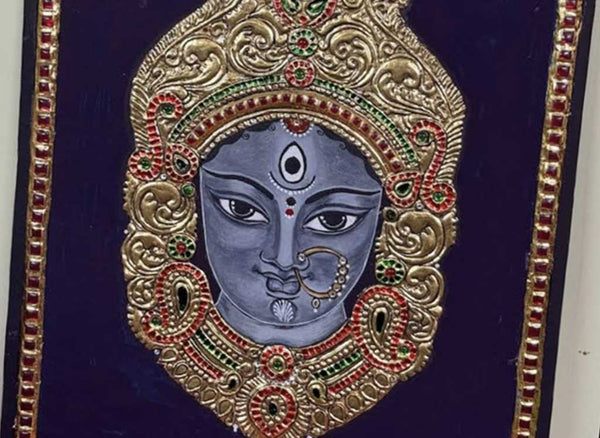
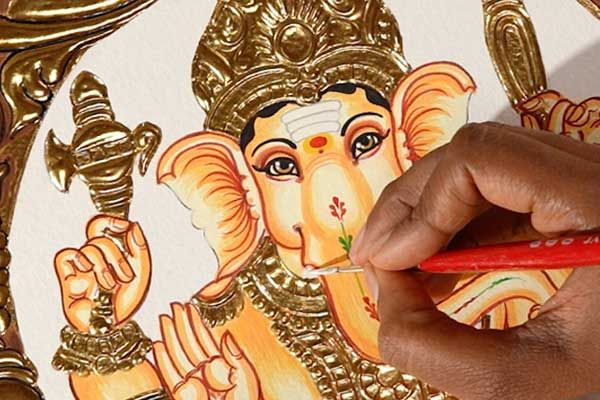
We always say that painting the face of the Devi is the most sacred part of the journey. It's also the part beginners worry about most. The eyes, the brows, the gentle line of the lips: this is where the deity's expression comes from, and it's where fine brushwork matters more than anywhere else.
That's exactly why the face comes so late in the order. We never ask you to start there. By the time you reach it, you've practised your brush control across the whole painting. And we take the face slowly, step by step, so you never feel rushed. It's often the moment the painting comes alive in front of you.
Watch the face come to life
What brushes do you need for Tanjore painting?
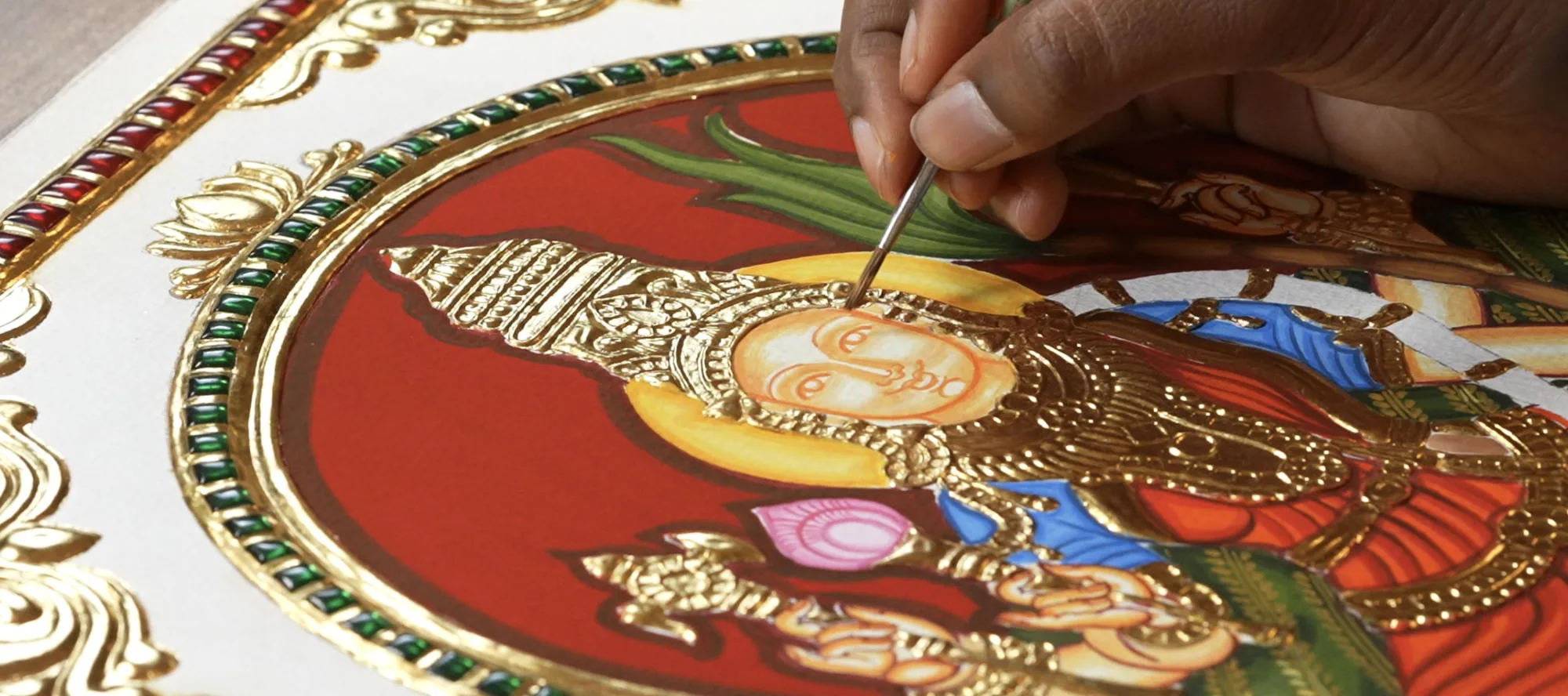
You need a few good, fine-tipped brushes that hold their point. Our Essentials Material Kit includes four premium, professional-grade brushes for exactly this reason.
Beginners often underestimate brushes, and it's one of the quietest ways a first painting gets held back. The fine, controlled work of a Tanjore painting, above all the face and the outlines, simply can't be done well with a coarse or worn brush. A good brush carries paint evenly, keeps a sharp tip, and lets you make the small, precise strokes that give the deity a serene expression. Larger areas like the background and garments are easier too when the brush lays colour smoothly instead of leaving streaks.
Caring for your paints and brushes
A little care keeps your materials working for many paintings. Rinse your brushes after each session, reshape the tips gently, and store them tip up so the bristles keep their point. Close your paint lids firmly after use so the colours don't dry out. And when you finish, several of our DIY courses close with a lesson on maintaining your painting, so the colours and gold stay beautiful in your home for years.
Frequently asked questions
Which paint is used in Tanjore painting?
We teach Tanjore painting with poster paints. They're applied after the gesso relief, kundan stones and 24 karat gold are in place, and they're built up in even layers around the gold.
What brushes do I need?
A few fine, professional-grade brushes that hold a sharp point, especially for the face and outlines. Our Essentials Material Kit includes four premium brushes.
In what order is a Tanjore painting coloured?
Broadly: the aura and lotus, the garments, the body, the face, the background, and the black outlines last, followed by Swarovski crystals. The exact steps vary a little by deity, and each of our courses walks you through them one by one.
Do I need to know how to paint before I start?
No. Most of our students have never painted before. Our kits come pre-sketched, and every colour, from the first wash on the lotus to the last line on the face, is taught step by step.
Want to see how paints fit alongside the gold, gesso and stones? Our complete guide to Tanjore painting materials brings every material together, and how a Tanjore painting is made walks through the full process.
More blog articles
Shiva Parivar Tanjore Painting Class: An Advanced Subject to Aspire To
The divine family of Shiva, and an advanced Tanjore painting worth working toward. Its meaning, its festivals, and how to reach it.
Lakshmi Narasimha Tanjore Painting Class: An Advanced Subject to Grow Into
Lakshmi Narasimha's meaning, his festival, and whether our advanced 10-week course is right for you.
Goddess Gajalakshmi Tanjore Painting Class: Meaning and How to Learn It
Who Goddess Gajalakshmi is, the festivals she is worshipped at, and how to paint her with us in a 6.5-week online or Bangalore studio course.
What our students say
Hear from students who've learned the art of Tanjore painting with us.