Lord Ganesha Tanjore Painting Class: Meaning and How to Learn It
Written by
Vibha Raj
Lord Ganesha is one of the best first subjects in Tanjore painting. What he represents, Ganesh Chaturthi, and how to learn to paint him with us.
Key takeaways
- Lord Ganesha, the remover of obstacles and lord of beginnings, is one of the most loved first subjects in Tanjore painting.
- We teach Ganesha as a self-paced DIY video course and a live online 6.5-week course. The DIY course offers 12 by 12 or 15 by 15 inches, and the live online course offers 10 by 12 or 12 by 15 inches.
- It is built for complete beginners: you are guided from the sketch and gold foil through to his face and ornaments.
- Ganesha is traditionally worshipped at Ganesh Chaturthi (Aug-Sep), the festival of his birth.
- Over 40 years we have taught 5,000+ students, with a 5.0 rating across 450+ Google reviews.
If you have been waiting to begin, Lord Ganesha is a beautiful place to start. He is the remover of obstacles and the lord of beginnings, invoked before anything new, which is exactly how it feels to pick up a brush for the first time. Many of our students paint Ganesha as their very first Tanjore painting, and finish it with a confidence they did not know they had.
Who is Lord Ganesha?
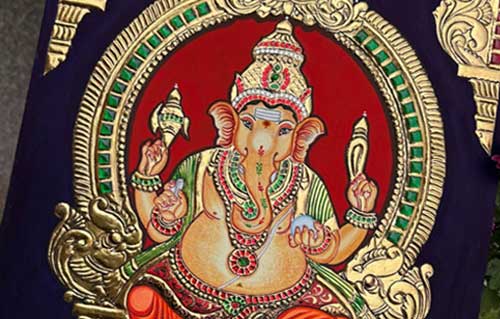
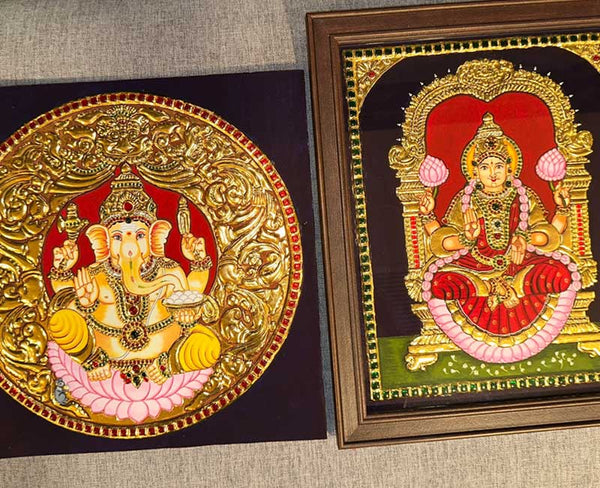
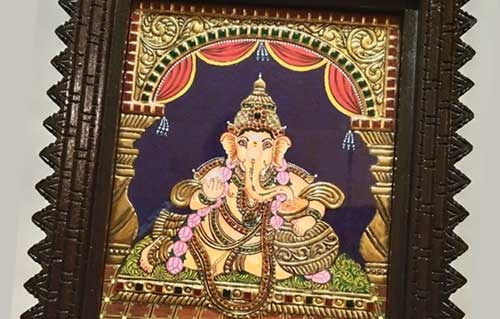
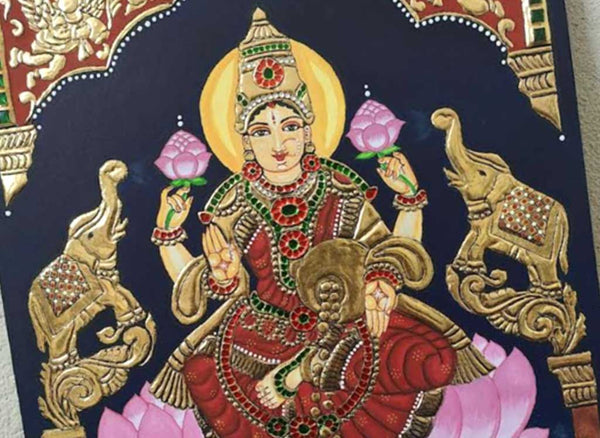
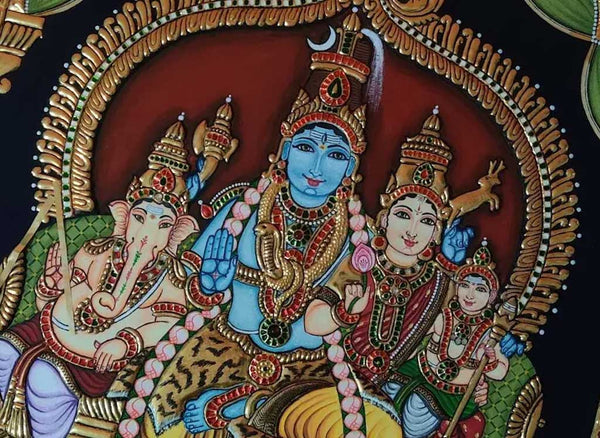
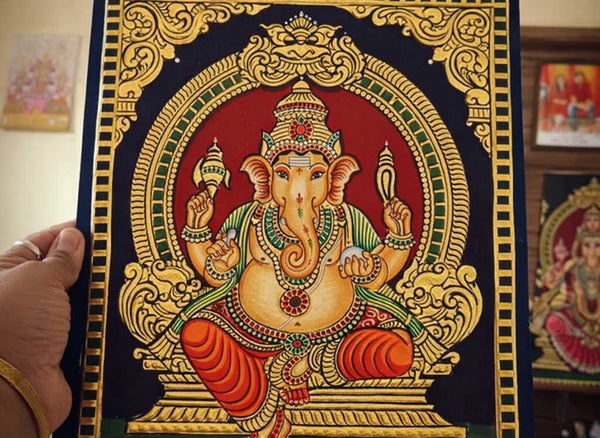
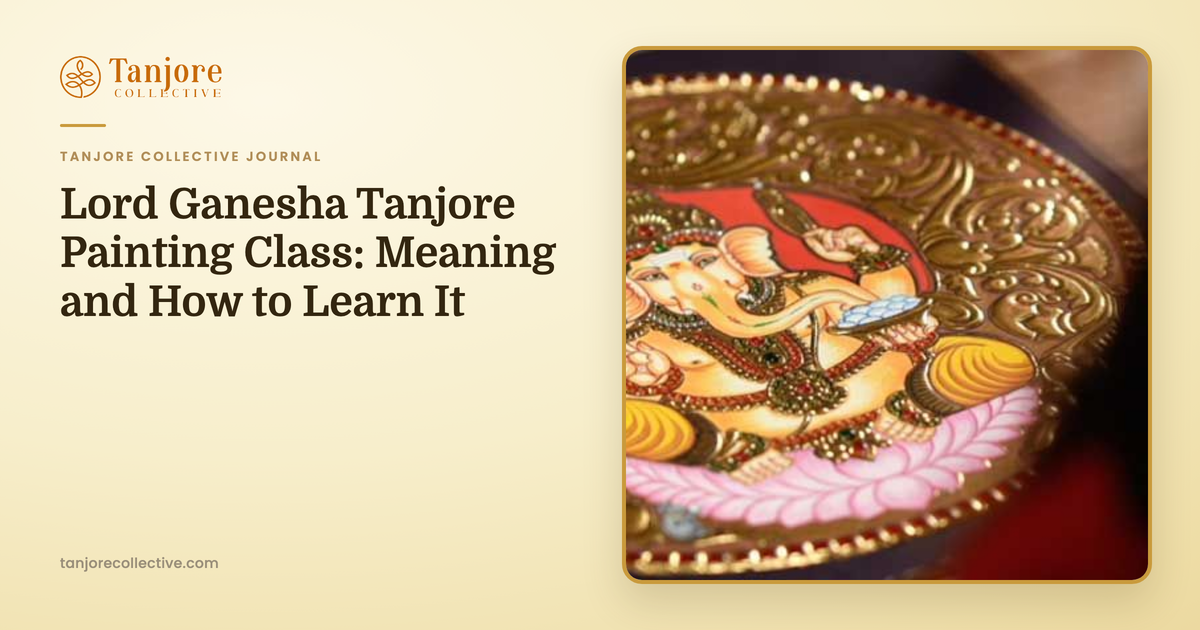
Ganesha is the elephant-headed son of Shiva and Parvati, revered as the remover of obstacles and the lord of new beginnings. He is invoked at the start of every venture, prayer and journey, and his gentle, generous presence makes him one of the most beloved deities in every home. In Tanjore painting he is shown seated and serene, framed in gold, his ornaments raised in relief, a figure of calm and good fortune.
Part of what makes Ganesha so loved is how much meaning he carries. His large head is a reminder to think big, his wide ears to listen more, and his small eyes to concentrate. The sweet modak in his hand is the reward of a steady practice, the small mouse at his feet is desire kept gently in check, and his single broken tusk speaks of sacrifice and of writing one's own story. Painting him slowly, feature by feature, is its own quiet meditation, and that is a large part of why so many people choose him as their very first piece.
What the painting shows
A Tanjore Ganesha is rich with meaning in every detail, and learning to paint him is also learning to read him. He is usually shown seated, calm and upright, within a gold arch called the prabhavali that frames him like a doorway into the shrine. He has four arms, and each hand tells you something. One holds the ankusha, the goad that steadies a wandering mind, another the pasha, the noose that gently draws you toward what is true, a third offers the modak, the sweet reward of a patient practice, and the fourth is raised in the abhaya gesture, a blessing that says do not be afraid. At his feet sits the little mouse, his vahana, and nearby the lotus, a sign of purity rising out of the everyday.
The palette is traditional and warm, deep reds and greens set against the glow of gold, with his form often in a soft coral or ochre. When you paint him, you place each of these elements with care, and by the end you understand not only how a Tanjore painting is built, but why it looks the way it does.
Why Ganesha is a wonderful first painting
Ganesha is one of the kindest subjects for a complete beginner. His form is forgiving, the composition is uncluttered, and there is only one face to paint, so you can give your full attention to learning the core techniques, the embossing, the gold, the colour, without feeling overwhelmed. You are never on your own either. Our courses are taught in guided batches with three to four teachers, and whether you learn live or at your own pace, a teacher is always a message away on WhatsApp. More than nine in ten of our students finish their painting, and for many, Ganesha is the one that convinces them they are, in fact, an artist.
When Ganesha is worshipped
Ganesha is especially worshipped at Ganesh Chaturthi, the festival of his birth, which falls in the month of Bhadrapada (August or September). It is a joyful ten-day celebration, and a Ganesha painting is a treasured presence in the home through it. He is also honoured at the start of any new undertaking through the year.
Why paint Ganesha for your home
Because he is the lord of beginnings, Ganesha is the deity most families welcome first, and a handmade Ganesha carries a warmth no print can. Many people place him near the entrance or at the heart of the puja room, so his gaze greets everyone who comes in and blesses every new venture that leaves. Painting him yourself adds another layer of meaning: the hours of quiet attention become their own small devotion, and the finished piece holds not just gold and colour but your patience and care. It is why a self-painted Ganesha is such a loved gift at Ganesh Chaturthi, a housewarming, or the start of something new.
Learn to paint Lord Ganesha
We teach Ganesha in two ways, a live online course and a self-paced DIY video course, both built for complete beginners. The DIY course offers 12 by 12 or 15 by 15 inches, and the live online course offers 10 by 12 or 12 by 15 inches, all comfortable sizes for a first piece. Here are the batches open right now.
What you learn and create
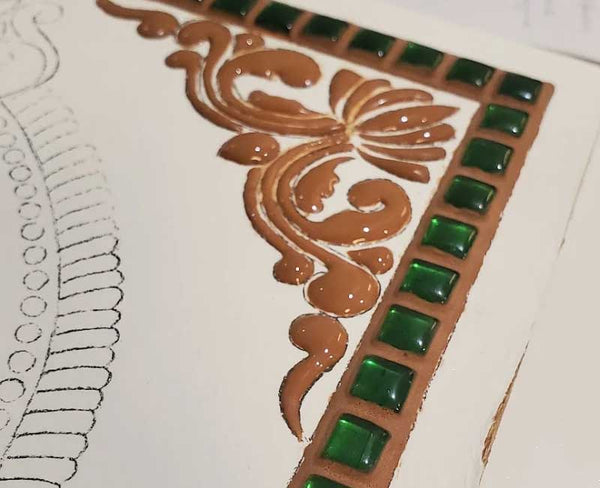
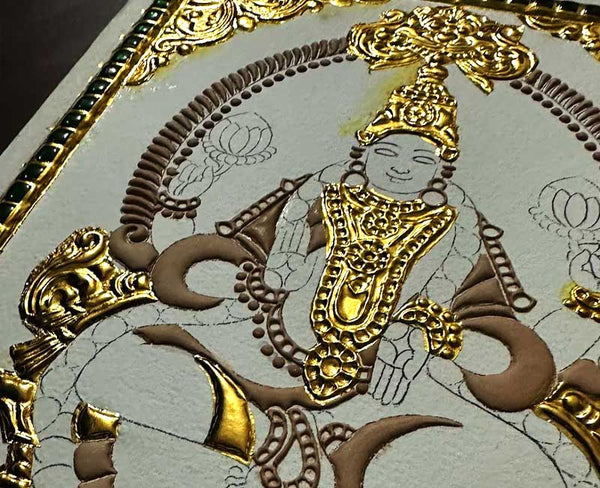
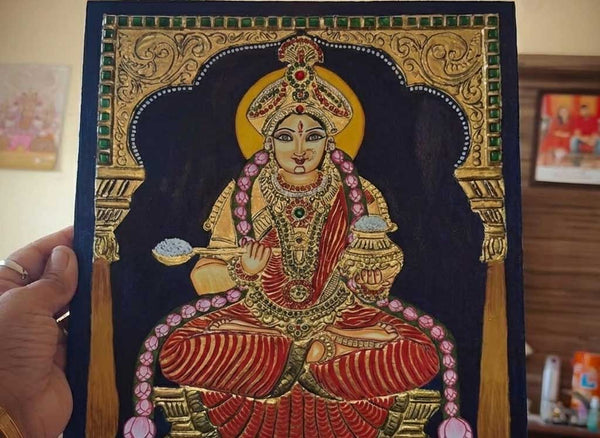
Over the course you build a complete Tanjore painting of Ganesha from a blank board to a finished, framed-ready piece, and you pick up the whole traditional technique along the way. You begin by preparing the canvas and transferring the sketch, so you do not need to know how to draw. Then you learn to mix and lay the gesso and gum relief that raises his crown, jewellery and arch into gentle three dimensions. Next comes the part everyone waits for, applying genuine 24-karat gold foil so the ornaments and halo catch the light the way a real Tanjore painting should.
With the gold set, you move to colour, learning how Tanjore pigments are built up and shaded, and then to the most loved stage of all, painting Ganesha's face and gentle eyes, the moment the deity truly comes to life. You finish by setting kundan stones and crystals and tidying the fine outlines. Each stage is broken down slowly and shown up close, so a complete beginner can follow, and you end with a finished painting worthy of your puja room. It is the same sequence that underlies every deity we teach, which is why Ganesha is such a strong foundation before you move on to subjects like Saraswati or the goddesses of abundance.
Your materials
The materials you need are provided with the course, including the pre-sketched canvas, genuine 24-karat gold sheets, and the stones and brushes, shipped to your door. You can learn more about the formats and what is included in our guide to online, studio and DIY classes.
Live online or at your own pace?
Both ways of learning Ganesha are built for beginners, so the choice comes down to how you like to work. The live online course gives you a fixed rhythm, two guided sessions a week with your teachers and a batch learning alongside you, which many people find keeps them moving to the finish. The self-paced DIY course lets you learn whenever suits you, pausing and rewatching as often as you like, with a teacher on WhatsApp to look at your photos and guide you. If you are not sure which fits your life, our honest online versus DIY comparison lays them side by side, and if you are nervous about starting at all, see how complete beginners learn with us.
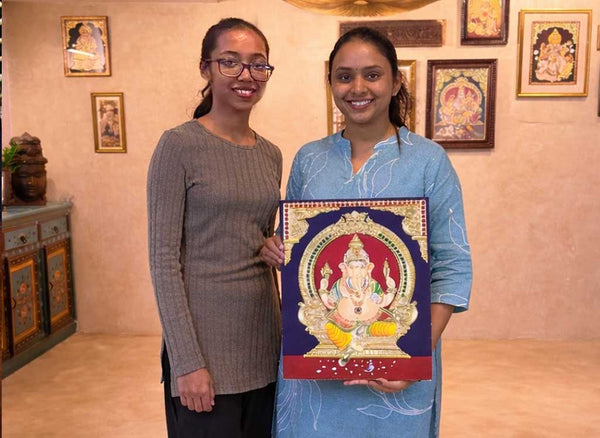
"Thank you Vibha and Yashaswini for being so patient in teaching each and every step of the process and making us so confident in completing the art with perfection."
Learn with us
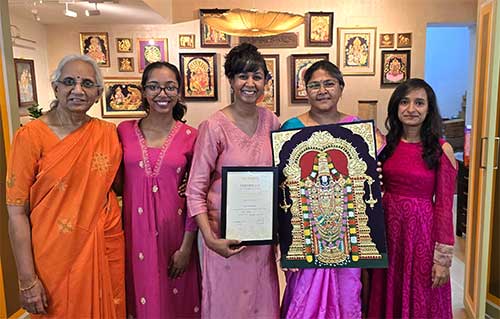
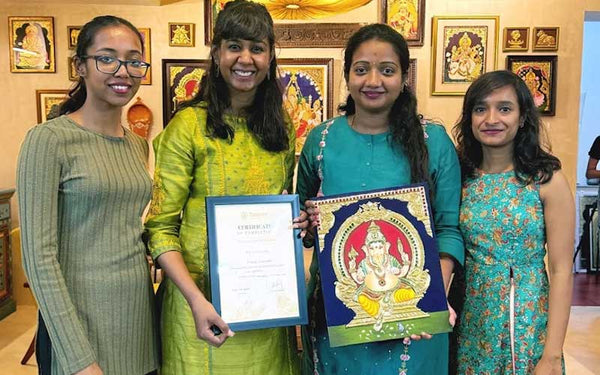
Every course is led by three to four of our artists, each taking the part they know best. Vibha Raj, our founder, is an award-winning Tanjore artist who learned the art from her mother, the master artist Vani Bhaskar, and she teaches the faces and the fine detailing. Spurthy GB, trained at the Karnataka Chitrakala Parishath, leads the gold-foil work, and Yashaswini Jaishankar, who began here as a student herself, guides the embossing and intricate detailing.
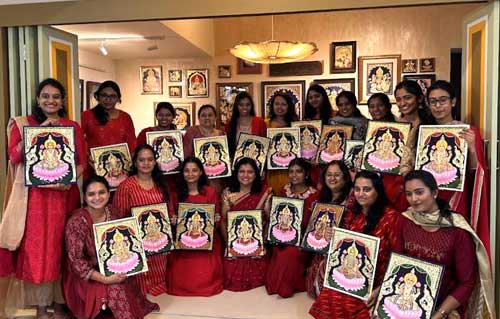
In four decades we have taught more than 5,000 students and created over 2,000 paintings across 100+ batches. Our work holds a 5.0 rating from 450+ Google reviews, and our studio and teaching have been featured in Deccan Herald, Hindustan Times, Deccan Chronicle and Incredible India.
Explore the rest of the deities we teach, or if Ganesha calls to you, pick a batch above and begin. We cannot wait for you to bring him to life.
Frequently asked questions
Is the Ganesha course good for beginners?
Yes, it is one of the best first subjects. The composition is kind and we guide you through every step, so a complete beginner can finish it with confidence.
What size is the finished painting?
It depends on the course you choose. The DIY video course is offered in 12 by 12 or 15 by 15 inches, and the live online course in 10 by 12 or 12 by 15 inches. Each course page lists the sizes for that batch.
Do I need to know how to draw?
No. The canvas comes pre-sketched and you transfer the outline, so you can begin with no drawing experience at all. The skill you build is in the embossing, the gold and the painting, and we teach each of those from the very first step.
What makes a hand-painted Tanjore Ganesha special?
Real Tanjore work uses genuine 24-karat gold foil and raised relief, so the ornaments catch the light with a depth a printed picture cannot match. Yours will be one of a kind, made by your own hand for your own home.
Can I learn Ganesha at my own pace?
Yes. Alongside the live online course, there is a self-paced DIY video course you can start anytime, with photo feedback from a teacher on WhatsApp.
How long does the Ganesha course take?
The live online course runs about 6.5 weeks, with two guided sessions a week. On the self-paced DIY course you move at your own pace, and your access is extended on request if life gets busy.
When is the next Ganesha batch?
The live course cards above show the current batches; the course calendar lists everything in one place.
Which deity should I paint after Ganesha?
Many students move on to Saraswati or Lakshmi, then to the more detailed subjects. See the full deities guide.
More blog articles
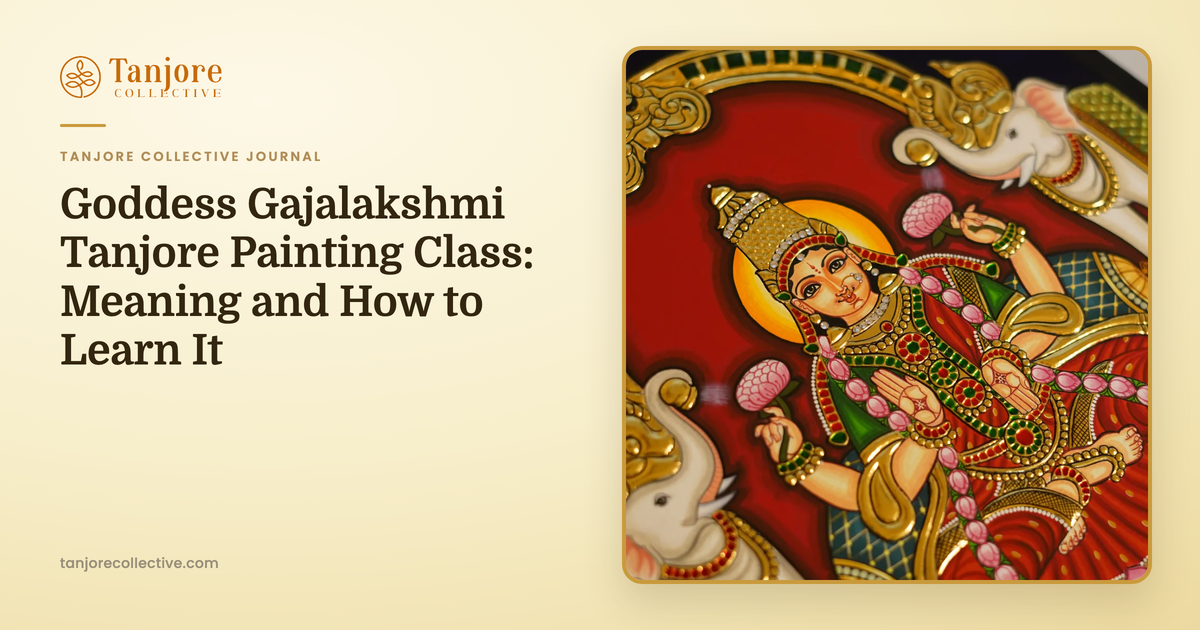
Goddess Gajalakshmi Tanjore Painting Class: Meaning and How to Learn It
Who Goddess Gajalakshmi is, the festivals she is worshipped at, and how to paint her with us in a 6.5-week online or Bangalore studio course.
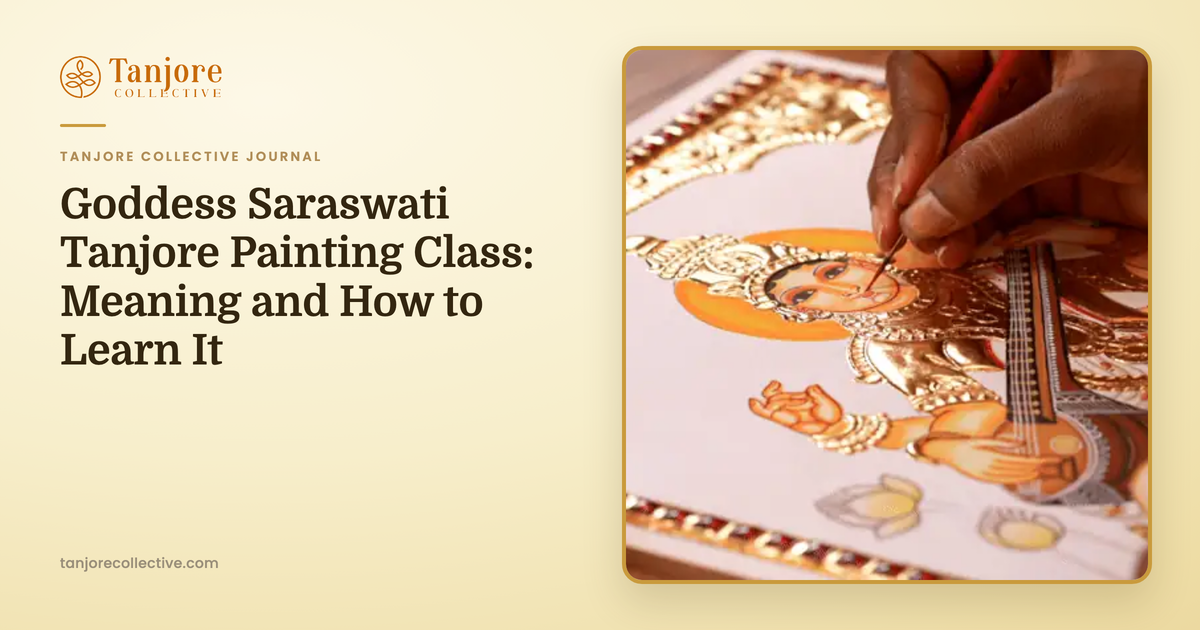
Goddess Saraswati Tanjore Painting Class: Meaning and How to Learn It
The meaning of Goddess Saraswati, her festivals, and how to paint her in the Tanjore style, step by step, as a complete beginner.
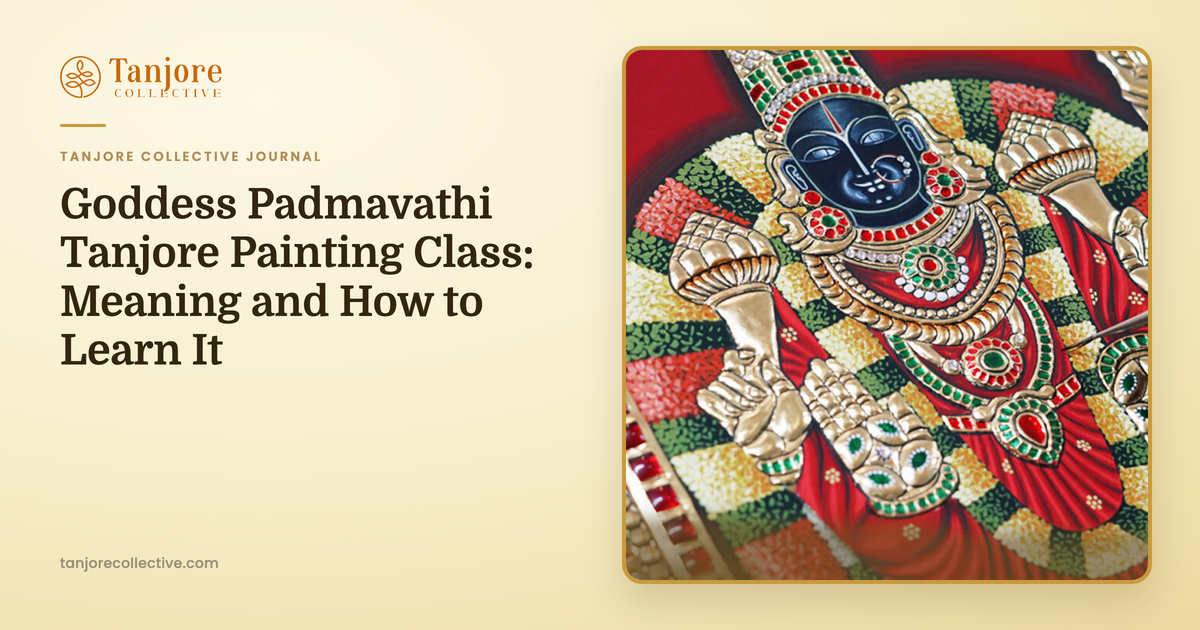
Goddess Padmavathi Tanjore Painting Class: Meaning and How to Learn It
Who Goddess Padmavathi is, when she is worshipped, and how to paint her in our detailed 9-week online course.
What our students say
Hear from students who've learned the art of Tanjore painting with us.