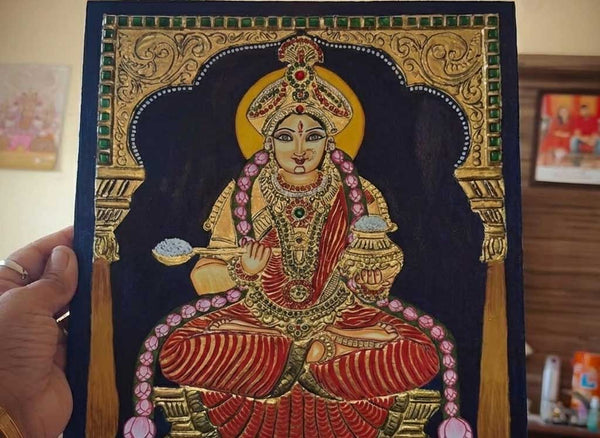
What You Need to Start a Tanjore Painting Practice: Skills, Materials and Mindset
Written by
Yashaswini Jaishankar
A grounded checklist for starting a serious Tanjore painting practice: the core skills in the order they're used, the materials and where to source them, the mindset, and your practice set-up.
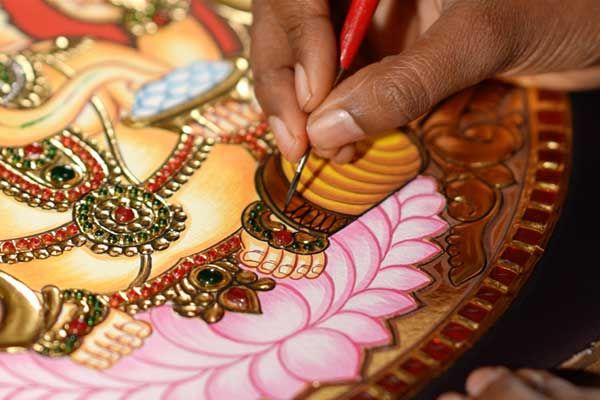
By Yashaswini Jaishankar, Head Teacher at Tanjore Collective. Yashaswini began as one of our students and now leads our classes, guiding students through the embossing and intricate detailing.
Key takeaways
- To start Tanjore painting professionally, you need four things: the core skills, the right materials, a patient mindset, and a regular practice set-up.
- The core skills follow the traditional order: canvas and sketch, kundan stones, gesso relief, 24 karat gold, painting and the face.
- Materials: a plywood board, chalk powder, Arabic gum, kundan stones, 24 karat gold sheets, paints, fine brushes and Swarovski crystals. Our Essentials Material Kit is Rs 4,000.
- Quality matters more than expense. Real gold and genuine stones are non-negotiable for professional work.
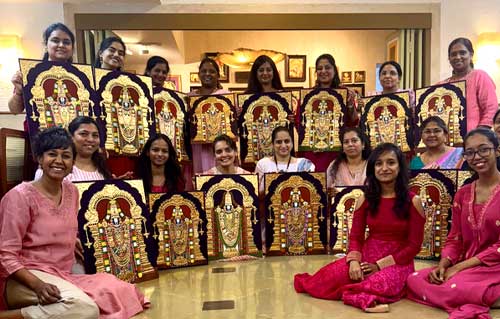
- Every artist and teacher on our team trained in our studio. In 40 years we've taught more than 5,000 students.
Somewhere between your second and third painting, something shifts. You stop following each step quite so nervously. You start noticing your own work: where the relief could be crisper, where the gold could lie smoother. And a new question appears. What would it take to do this seriously?
That's a good question to ask, and we hear it often. So here's our grounded checklist for starting a serious Tanjore painting practice: the skills, the materials and where to get them, the mindset, and how to set yourself up to keep painting. If you're weighing up whether to make it a career, our guide to a Tanjore painting career covers the bigger picture.
What do you need to start Tanjore painting professionally?
You need four things, and you can build all of them one painting at a time:
| What you need | What it means in practice |
|---|---|
| Skills | Confident control of every stage, from sketch to face |
| Materials | Real 24 karat gold, genuine stones and a properly prepared board, from a source you trust |
| Mindset | Patience, repetition and the habit of finishing |
| Practice set-up | A calm space, good light, a regular routine and, in time, your own designs |
Which skills should you build first?
Build the skills in the same order the painting is made: canvas and sketch, kundan stones, gesso relief, gold, painting and the face. Each one rests on the one before it, so getting the early stages right makes everything after them easier.
The sketch
Every Tanjore painting starts with the deity's outline on a prepared board. While you're learning, our boards come pre-sketched, so you can focus on technique. As you move toward professional work, you'll start drawing your own compositions, and that begins with practising the proportions and lines of the deities you know best.
Kundan stones and embossing
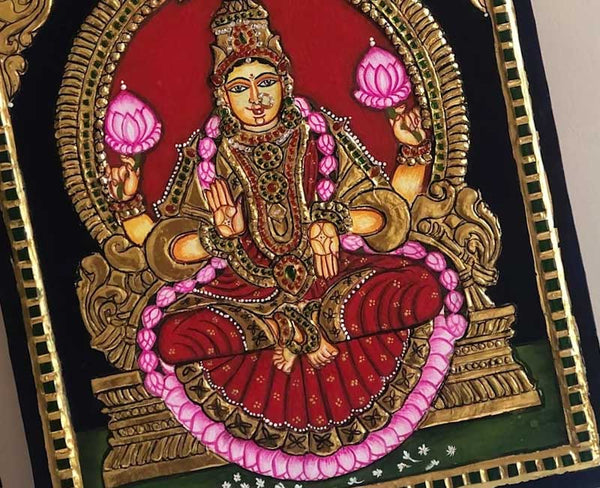
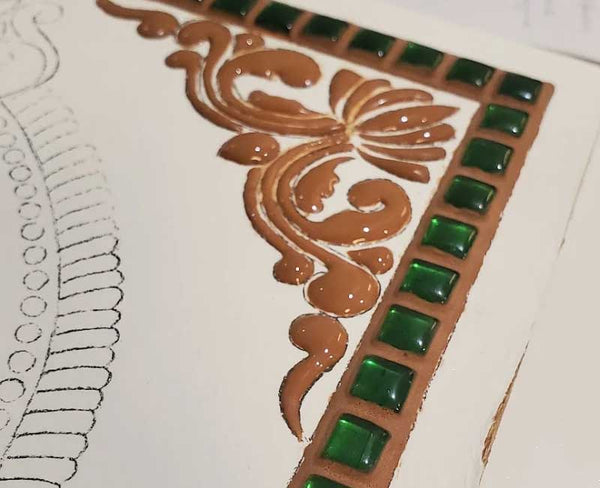
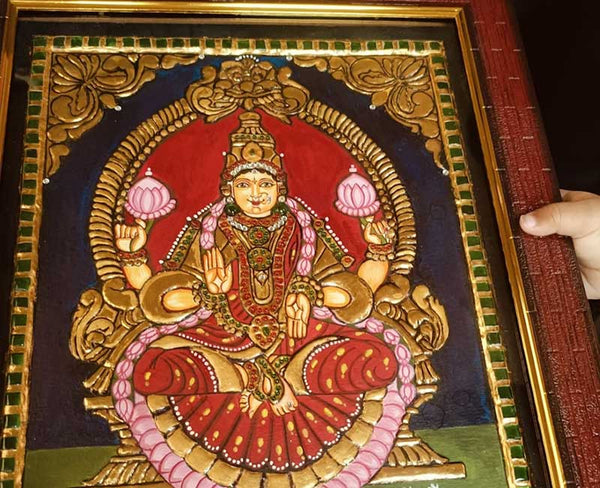
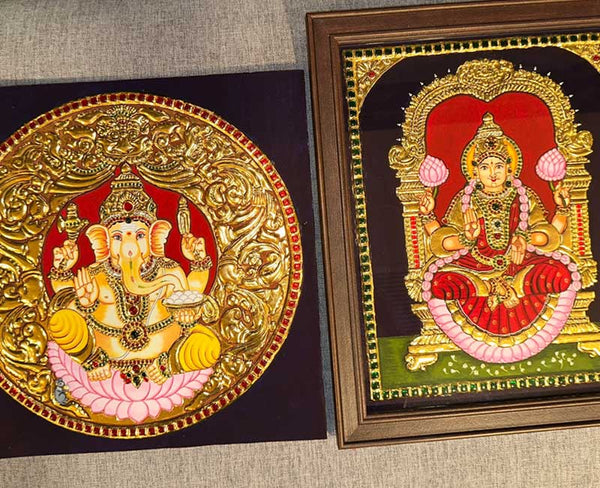
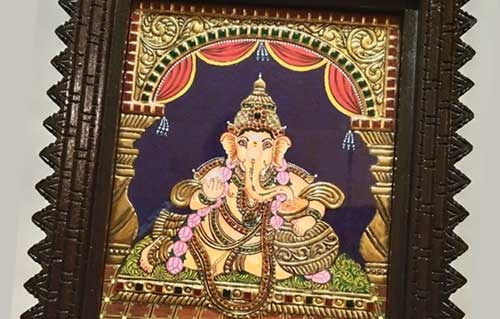
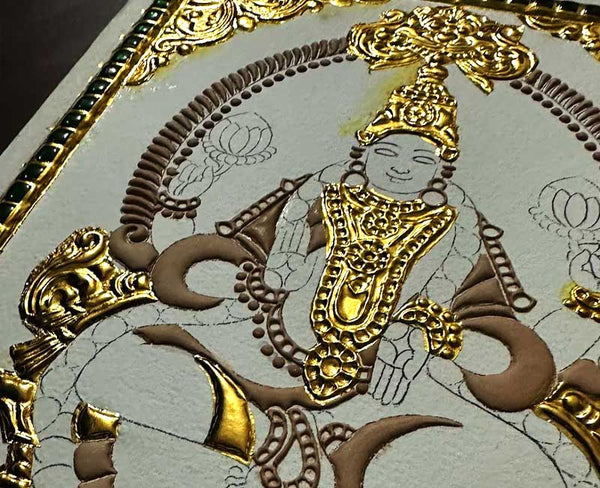
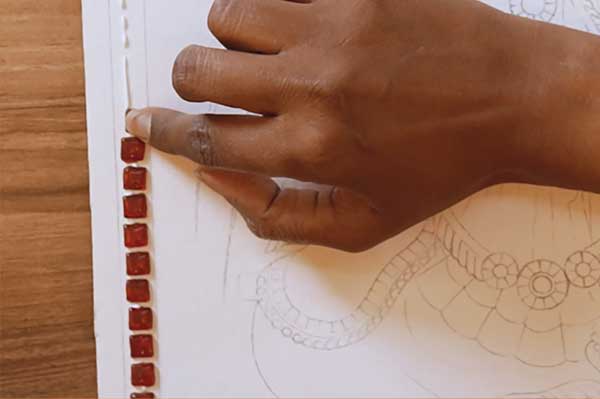
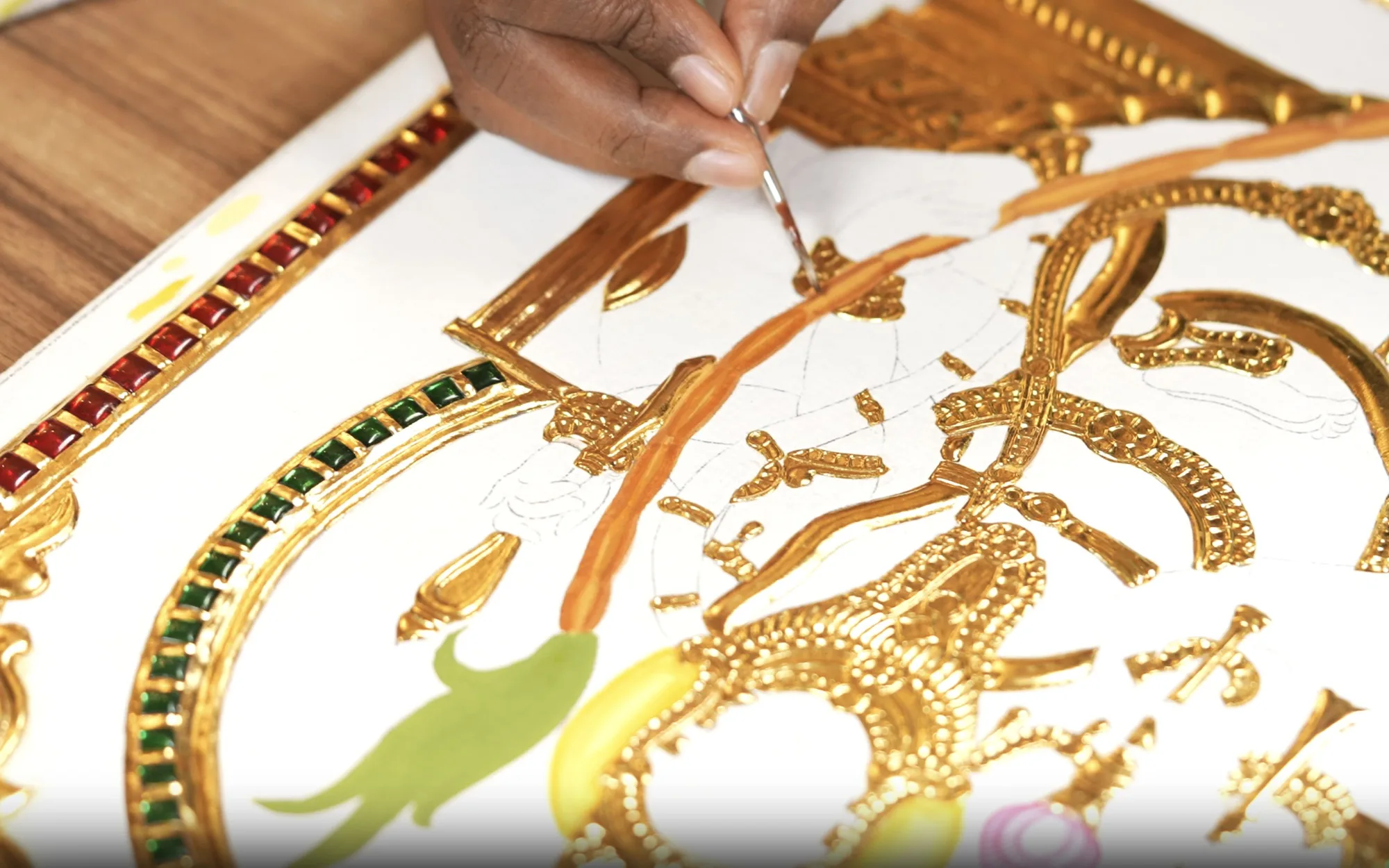
Kundan stones go onto the sketch first. Then the gesso, a paste of chalk powder and Arabic gum, is built up by hand around them into the raised crowns, arches and jewellery. In our courses, embossing takes two to three sessions. It's slow, careful work, and crisp, even relief is one of the clearest signs of a skilled hand. Our guides to kundan stones and gesso go into both.
Gold work
Real 24 karat gold leaf is laid over the relief and around the stones, held with Arabic gum. This also takes two to three sessions in our courses. Gold leaf is thin and delicate, and laying it smoothly over curved relief, without wrinkles or gaps, takes practice.
Painting and shading
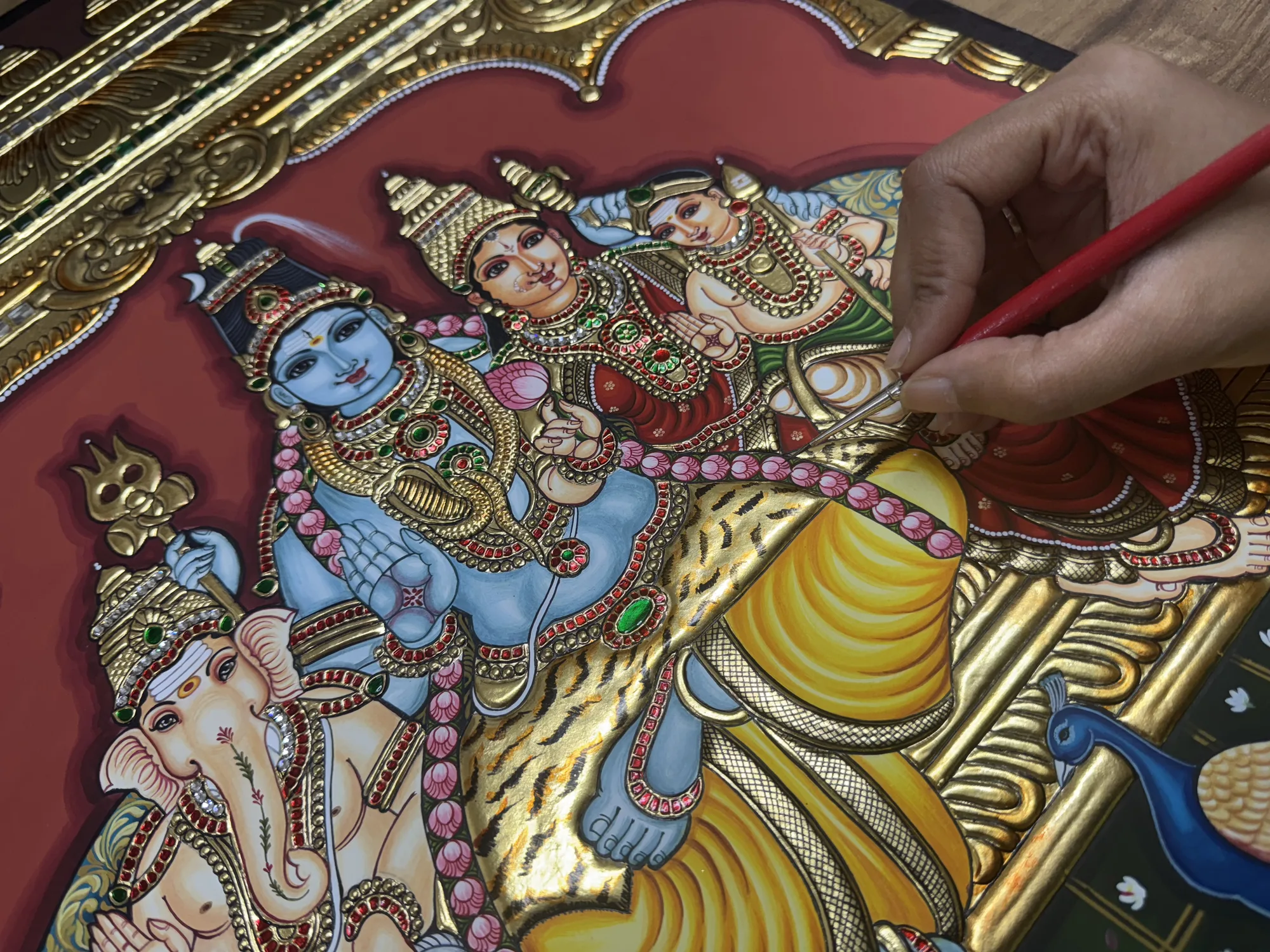
Colour comes after the gold. We teach with poster paints, building the lotus, the garments, the background and the body, then shading the body gently so the deity feels rounded and alive. Our guide to Tanjore painting colours and brushes walks through the painting order.
The face
The face comes near the end, and it's the most sacred and delicate part of the painting. Patrons look closely at the face, so it needs to be serene and even. It's also the skill that takes longest to make reliable, which is why it's worth painting many deities before you call yourself ready.
What materials do you need, and where do you source them?
You need eight core materials, and for professional work, every one of them has to be the real thing. Here's what to look for in each:
| Material | What to check |
|---|---|
| Plywood board | Sturdy and properly prepared, so the layers grip and last |
| Chalk powder and Arabic gum | Enough for both the canvas preparation and the gesso; kept dry |
| Kundan stones | Genuine kundan, not plastic substitutes |
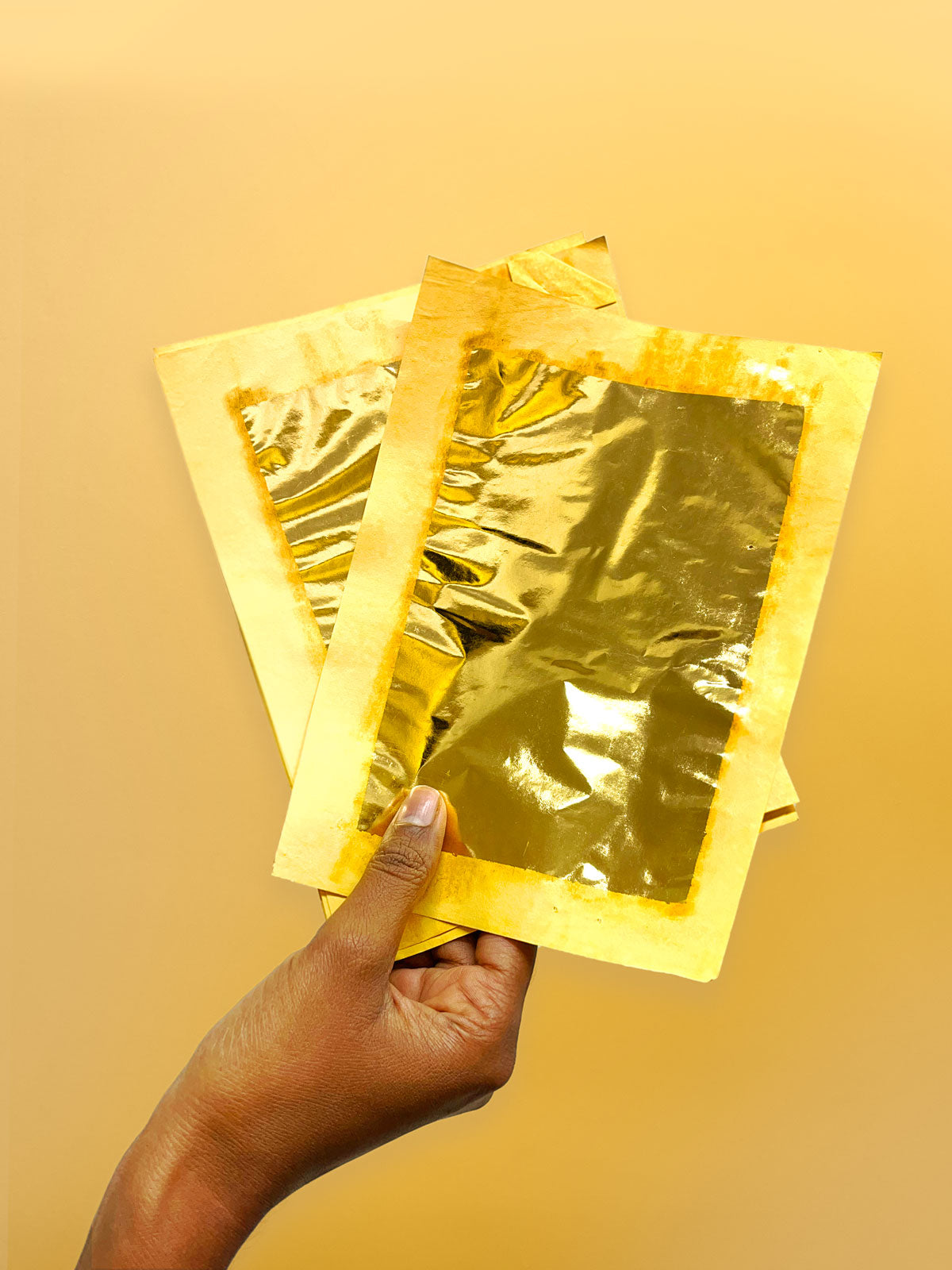
| 24 karat gold sheets | Real gold, and the karat stated clearly; purity matters for shine and longevity |
| Paints | Good-quality colours that lay evenly around the gold |
| Brushes | Fine, professional-grade brushes that hold a sharp point for the face |
| Swarovski crystals | Original crystals for the final sparkle |
Where to source them
Source from suppliers you trust, and ask plain questions: is the gold real, and what karat? Are the stones kundan? Are the crystals genuine Swarovski? Quality is hard to judge when you're starting out, and cheap substitutes can quietly hold back even good technique.
The simplest way to begin is with a curated kit. Our Essentials Material Kit is Rs 4,000 and includes a pre-sketched canvas, 24 karat gold sheets, Arabic gum crystals, chalk powder, kundan stones, original Swarovski crystals and four premium brushes, all handpicked and tested. It's the same quality our students paint with, and it ships to your door. You can see everything in it on our material kits page, and our full materials guide explains what each one does.
What mindset does a serious practice need?
Patience, repetition and the habit of finishing. These matter far more than natural talent. Our founding belief is that "there is an artist in all of us," and that passion is the only prerequisite.
- Patience. Tanjore painting can't be rushed. Each stage needs to settle before the next. The people who do well are the ones who are happy to go slowly.
- Repetition. Skill comes from painting the same techniques again and again, across different deities and sizes. Many of our students come back for a second and third deity, and that's exactly how control grows.
- Finishing. Every completed painting teaches you more than an unfinished one. More than 95% of our students finish their painting, and that habit is worth keeping.
And if you're still a beginner, that's fine. Most of our students have never painted before, and every artist on our own team started at a board, just like you.
Watch: where every painting begins
Embossing in our studio: crisp, patient relief is the foundation of every painting.
How do you set up to practise?
Give yourself a calm space, good light, a regular routine and, as you grow, your own designs.
- A still space. Gold leaf is so light it moves with a draught, so work somewhere calm, with clean, dry hands.
- Good light. You'll be painting faces and fine outlines, so work where you can see detail clearly.
- Dry storage. Keep your chalk powder and Arabic gum dry and sealed, since damp spoils them. Store gold flat and protected, and keep your brushes rinsed, reshaped and stored tip up.
- A routine. Our courses run two sessions a week, and that rhythm works well at home too. Regular, unhurried sessions beat occasional long ones.
- Your own designs. Course sketches are our own designs, made for your learning. To sell your work, use sketches you've created, bought or licensed. Our guide on how to sell Tanjore paintings covers this.
Keep learning as you practise
Even a serious practice benefits from a teacher's eye. Moving on to larger, more detailed subjects, such as Lord Balaji or Goddess Padmavathi (about 2.5 months) or the advanced 10-week Lakshmi Narasimha course, stretches your range in ways solo practice can't. Our guide on how to become a Tanjore artist lays out that path stage by stage.
Frequently asked questions
What materials do I need to start?
A plywood board, chalk powder, Arabic gum, kundan stones, 24 karat gold sheets, paints, fine brushes and Swarovski crystals. Our Essentials Material Kit brings them together for Rs 4,000, with the board pre-sketched.
Do I need expensive supplies?
You need real supplies more than expensive ones. Real 24 karat gold and genuine kundan stones matter, because substitutes show in the finished painting. A curated kit is the simplest way to get the right quality without guesswork.
Where do I source gold and stones?
From a supplier you trust, who can tell you plainly what karat the gold is and whether the stones are genuine kundan. Our Essentials Material Kit includes 24 karat gold sheets, kundan stones and original Swarovski crystals.
Can a beginner start a serious practice?
Yes. Most of our students start as complete beginners. Begin with one finished painting, then keep going, one deity at a time.
More blog articles
Tanjore Painting Colours and Brushes: What We Use and Why
Which paints and brushes go into a Tanjore painting, and the order a deity is coloured in.
Shiva Parivar Tanjore Painting Class: An Advanced Subject to Aspire To
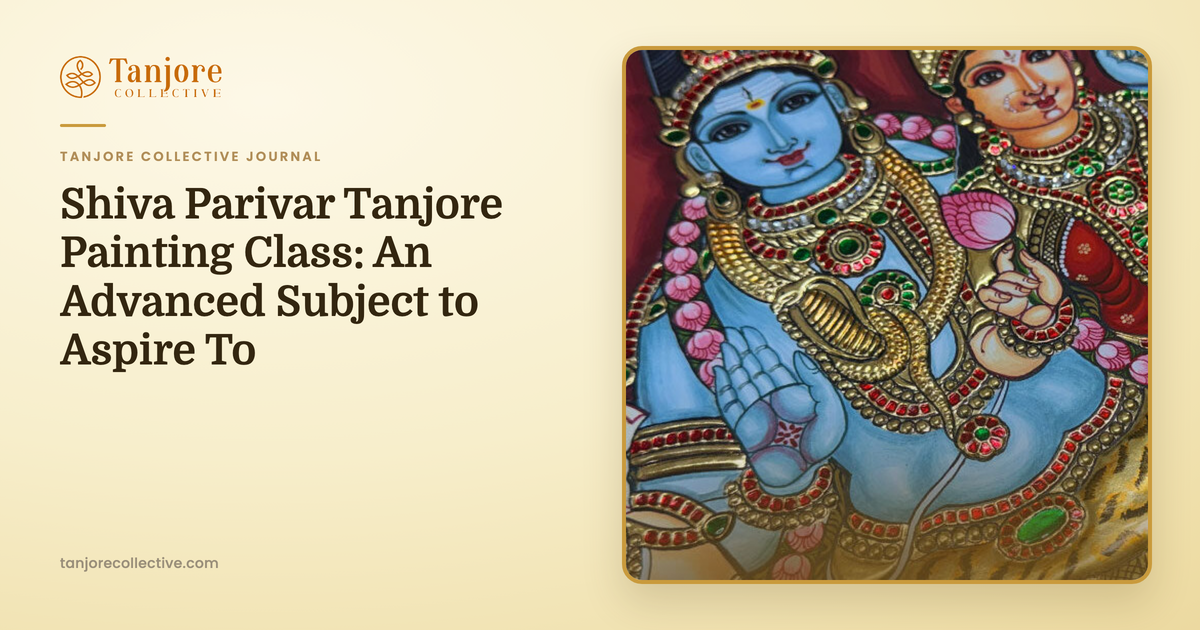
The divine family of Shiva, and an advanced Tanjore painting worth working toward. Its meaning, its festivals, and how to reach it.
Lakshmi Narasimha Tanjore Painting Class: An Advanced Subject to Grow Into
Lakshmi Narasimha's meaning, his festival, and whether our advanced 10-week course is right for you.
What our students say
Hear from students who've learned the art of Tanjore painting with us.